
I’ve loved dark art for years. I’m drawn to the detail, the atmosphere, and the imagination it takes to make a creature that has never existed feel completely believable. A strange face or an impossible landscape can hold my attention for a long time. There is always something else to find.
With Halloween coming up, it felt right to begin CIRRUS here: with an artist I’ve admired for years, a gallery I love, and an opening night that brought those things together. On October 10, I went to Copro Gallery in Santa Monica for Chet Zar’s The Temptation of Saint Anthony. I got to meet Chet again and take a photo with him in front of the new painting.
A gallery I keep coming back to
Copro is one of my favorite galleries, especially for dark art. It is a place I associate with artists whose work rewards a closer look: unusual characters, meticulous surfaces, and whole worlds compressed into a painting. For the kind of art I love, it is an essential stop.
The gallery has a long history behind it. Its own account dates its founding to 1992, names Joe Copro, Greg Escalante, and Douglas Nason as its founders, and records its move to Bergamot Station in 2005. Escalante also co-founded Juxtapoz; Gary Pressman became Copro’s owner in 2017. That connection to the wider lowbrow and contemporary art community is part of what makes the gallery’s programme worth following. [1]
There is something special about seeing this work in a room rather than only on a screen. You can move closer, step back, and let a small detail change your understanding of the whole piece. A gallery gives the work the time and physical presence it deserves.
Chet Zar, on a different scale
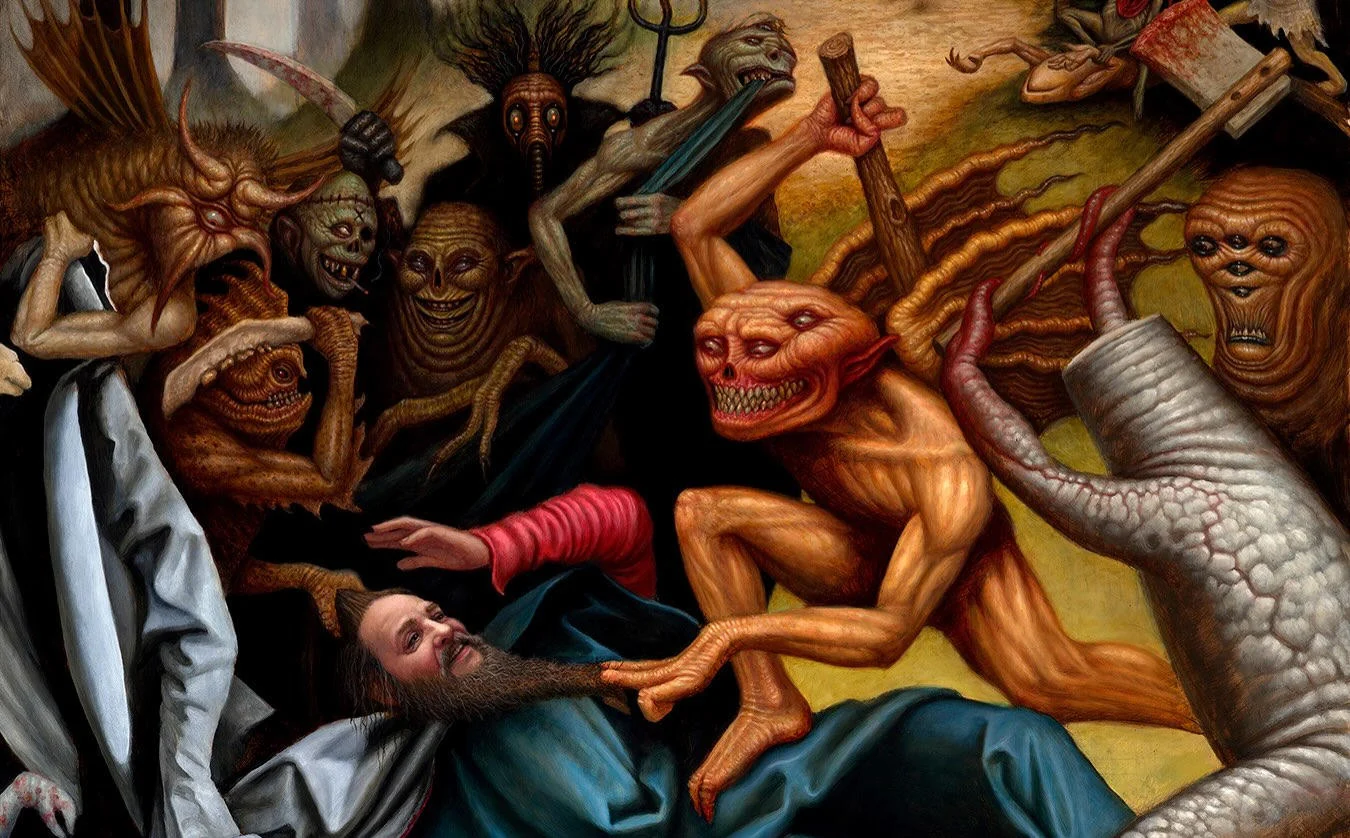
Copro presented The Temptation of Saint Anthony as Chet’s largest painting to date: a six-by-four-foot oil painting, accompanied by studies made during its development. The gallery identifies Matthias Grünewald’s version of the subject as a particular inspiration. Chet carries that historical starting point into his own unmistakable world of creatures. [2]
In the finished image, a pale landscape and rising columns of smoke sit above a crush of bodies, teeth, horns, cloth, and skin. Every creature has a different physical character. The folds, the changing textures, and the expressions keep pulling my eye around the painting. I admire that ability to give so much individuality to a crowded composition.
In Natalia Joruk’s preview and short interview for Beautiful Bizarre, Chet talks about the challenge of painting so many distinct characters, working at this scale, and the decision to paint himself as Saint Anthony. He had wanted to make his own interpretation for many years. Reading that background adds another layer to the self-portrait at the centre of the scene. [3]
The painting was supported through a Copro Kickstarter campaign. Rue Morgue covered the project before the opening, connecting it to Chet’s earlier ambitious exhibitions and his background in creature effects. That wider history is useful context, but my admiration always comes back to the work itself. His level of detail and the consistency of his own visual language are, to me, second to none. [4] [5]
From Hell City to Copro
The first time I met Chet was at Hell City in 2016. Since then, I’ve met him a few more times at tattoo conventions and gallery openings over the years. He is an incredible artist I continue to admire and look up to. Getting to see him again, standing beside this latest painting, brought that history back into focus.
I’ve included two of his inscriptions from Black Magick: The Art of Chet Zar: one addressed to Cloud, the other to Cameron. The signatures and skull drawings make those pages personal to me. They are small reminders of the times that an artist’s work has led to a real encounter, and of why I keep going to these shows.
Black Magick is part of that personal history. I like having a physical book to return to: something I can sit with, open to a different page, and notice again. The drawings and inscriptions make it a record of my connection to an artist whose work has meant a lot to me.
Black Magick: The Art of Chet Zar, from my collection. Photo supplied by Cameron Cloud; cover artwork © Chet Zar.Phil Tippett’s handmade worlds
Sharing the October programme was Phil Tippett’s Artifacts of a Mad God: An Excavation. Copro’s presentation brought together materials from Mad God, including drawings, storyboards, puppets, props, and miniature sets. It offered a way into the physical work behind the film. [2]
Tippett’s own studio describes Mad God as a practical stop-motion project built from handcrafted creatures and environments, developed across decades. His film work includes Return of the Jedi and Jurassic Park, for which he received Academy Awards. There is a clear connection, for me, between the care in those fabricated worlds and the care in Chet’s painted ones: the conviction that an imagined thing deserves to be made with extraordinary attention. [6] [7]
The exhibition also arrived at a significant moment. Tippett’s longtime Berkeley workshop closed in August 2026, with decades of props and equipment dispersed through a liquidation sale. The retirement headlines need some care: Animation World Network reported that Tippett Studio’s Toronto operation continued, and that Tippett himself was not finished creating. The closing of the Berkeley workshop marks the end of a particular chapter, rather than a simple farewell to his art. [8]
That distinction matters to me. The space where work is made can change, but the work—and the imagination behind it—can keep finding new forms. Exhibiting the surviving objects gives people a chance to appreciate the hands, decisions, and persistence that went into them.
Four artists, four different worlds
The October opening also included Gabe Leonard’s Totally Under Control and Katie Gamb’s Grounding. Leonard’s own exhibition page places his show within this four-artist programme. Copro’s catalogue for Gamb includes oil paintings such as Does the Spirit Remain? and Rebuild, Then Rebuild Again. Their inclusion is a reminder of the range a gallery like Copro can hold within a single opening. [9] [10]
Why CIRRUS begins here
Halloween gives this first story its timing, but my interest in dark art continues throughout the year. I love finding work that is technically accomplished, deeply individual, and a little difficult to explain. It makes me curious about the person who made it and the choices that brought it into being.
That curiosity is what I want to bring to CIRRUS. Artists, musicians, studios, shows, and the people building worlds of their own. Some stories will come from discoveries; others will come from going somewhere and meeting the people behind the work. This one begins with a gallery I love and an artist I’m grateful to keep encountering.